The Other Kenya
North of the Mara and east of the Rift, the land rises into a high, arid plateau of escarpments, granite kopjes and acacia plains that stretches toward the snows of Mount Kenya. This is Laikipia and the conservancies of the north — a Kenya that few visitors ever see, and the one that those who know the country best return to again and again. Where the Mara is theatre, Laikipia is sanctuary: vast private and community-owned conservancies where the density of vehicles is low, the wilderness runs uninterrupted for tens of thousands of acres, and the wildlife you encounter is, increasingly, found nowhere else.
It is here that the most important conservation work in East Africa is being done — and done in a way that places the discerning traveller at the very heart of it. The Lewa Wildlife Conservancy, a UNESCO World Heritage Site, protects over ten percent of Kenya's black rhino and the largest single population of the endangered Grevy's zebra on Earth. The Loisaba Conservancy, in the Ewaso ecosystem, shelters Kenya's second-largest elephant population and the almost mythical black leopard. And in Meru National Park — the storied ground of Born Free — an eighty-four-square-kilometre rhino sanctuary quietly thrives in a park that almost no one visits.
The Conservancies
The genius of Laikipia is structural. Rather than a single national reserve open to all, the region is a mosaic of private and community conservancies, each managing its own land, its own wildlife, and its own guest numbers. The result is exclusivity in the truest sense: at Loisaba Tented Camp, the arithmetic works out to roughly 4.8 square kilometres of wilderness for every bed — among the most private safari experiences anywhere in East Africa. Game drives go off-road, night drives are permitted, and the spectacle is yours alone rather than shared with a column of vehicles.
Lewa, to the east, is the conservation flagship — a UNESCO World Heritage Site holding over ten percent of Kenya's black rhino, some fifteen percent of its white rhino, and the world's largest single population of the critically endangered Grevy's zebra. Loisaba, in the wider Ewaso ecosystem, is a working conservation laboratory where research programmes run by The Nature Conservancy — Space for Giants, the reticulated giraffe study, Lion Landscapes — operate on the land you traverse. And Meru, the wildest of the three, offers an eighty-four-square-kilometre rhino sanctuary in near-total solitude. To stay in any of them is not to observe conservation from a distance, but to fund it directly and witness it at work.
The Rarest Wildlife in Kenya
Laikipia rewards the traveller who already knows the Big Five and is ready for what comes next. This is rhino country above all — both black and white, tracked on foot and from the vehicle across Lewa and Meru, where breeding populations are growing and calves are now a regular sight. It is also the heartland of the northern specials: the finely striped Grevy's zebra, the reticulated giraffe, the long-necked gerenuk that browses on its hind legs, the Beisa oryx and the greater kudu — species barely seen on the classic southern circuit.
Loisaba adds the prize that even seasoned safari-goers travel for: the elusive black leopard, one of the rarest big-cat sightings in Africa, photographed here more reliably than almost anywhere on the continent. The region is also a stronghold for elephant — Laikipia holds Kenya's second-largest population, with Loisaba serving as a critical breeding area and migration corridor. Lion, cheetah, buffalo and the full supporting cast complete a picture that is, quietly, one of the richest in Africa.
Where to Stay
The properties of the region range from the residential to the theatrical, and the choice is part of the pleasure. Kifaru House, set on manicured lawns within Lewa, is intimacy itself — just five thatched cottages with the feel of a private home. Lewa Safari Camp, the only lodge inside the conservancy owned by the conservancy itself, channels every shilling of its profits back into the cause.
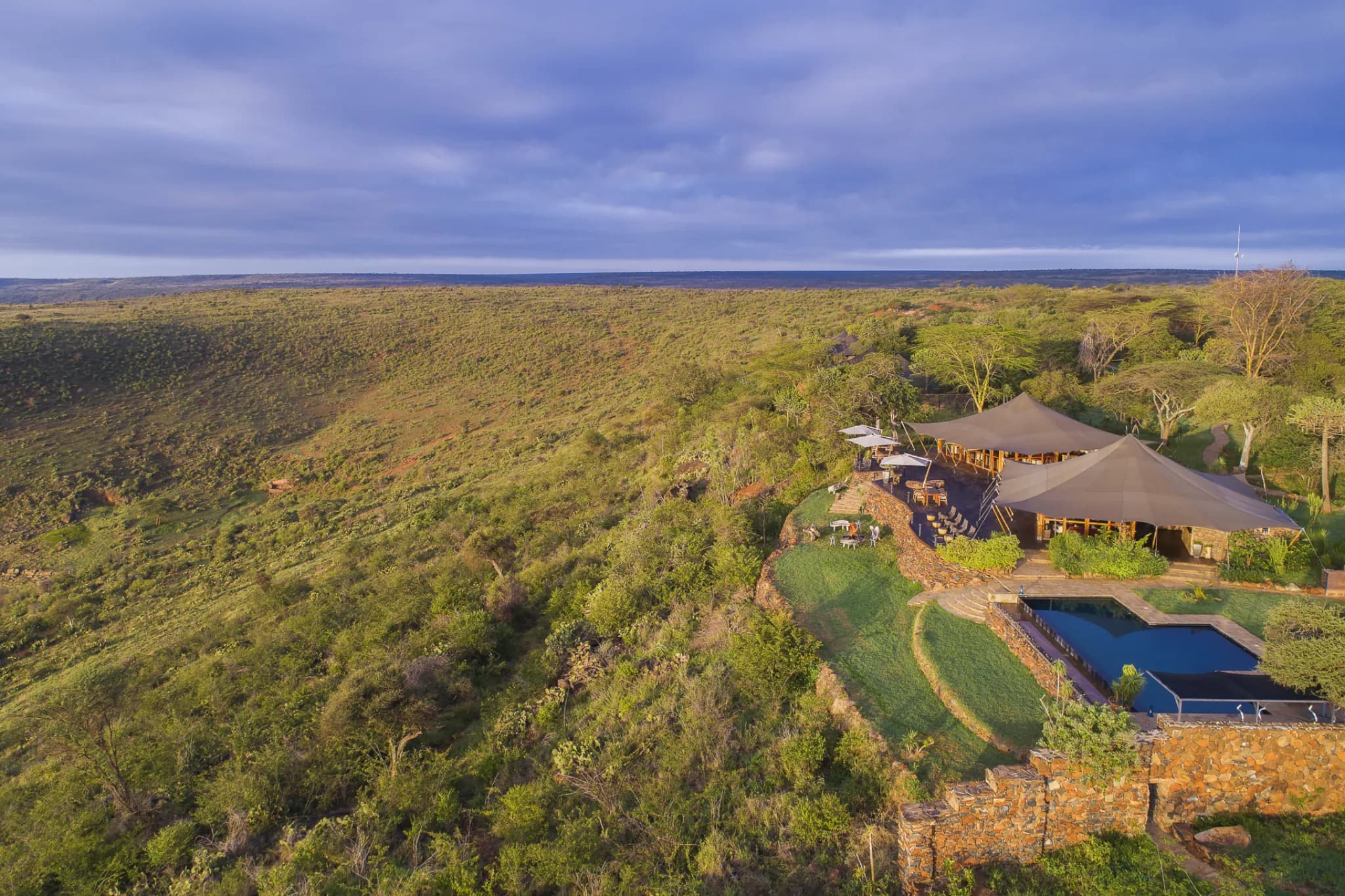
In Loisaba, the same wilderness can be inhabited three ways. Lodo Springs offers eight escarpment tents, each with its own dedicated guest ambassador. Loisaba Tented Camp commands the escarpment edge with an infinity pool that seems to spill toward Mount Kenya. And the Loisaba Star Beds dispense with walls altogether: handcrafted four-poster beds, rolled out each night on a kopje above a waterhole, hosted by Samburu and Laikipia Maasai warriors, beneath a sky undimmed by any light for a hundred miles. In Meru, Elsa's Kopje is built directly into Mughwango Hill, overlooking the site of George Adamson's old camp — the very ground of the Born Free story.
Conservation You Can Witness
What sets the north apart is the degree to which conservation is not a backdrop but an experience. At Lewa and Loisaba, guests can visit the conservancy headquarters to understand how a modern conservancy is run, and watch the anti-poaching tracker dogs — trained sniffer units that have transformed the fight against poaching — at work. On Lewa, a prehistoric site thought to be an ancient tool-maker's workshop has been studied by the National Museums of Kenya, whose pre-history department was made famous by the Leakey family; guides share its findings on the plains where they were made.
The human story runs just as deep. The conservancy model funds schools, clinics and water projects across the communities who share the land, and cultural visits to Samburu and Maasai villages are genuine exchanges rather than performances. For families, the warrior training offered at the Loisaba camps — making fire, throwing a spear, fashioning a bow — doubles as a real cultural education. It is conservation and community woven so completely into the stay that the distinction dissolves.
Practical Considerations
GETTING THERE
The conservancies are reached by light aircraft from Nairobi's Wilson Airport. Lewa Main Airstrip is roughly a 45-minute flight followed by a 15-minute drive; Loisaba is about an hour in the air, then 15 minutes by road; Meru is around 45 minutes' flight with a short transfer beyond. The aerial approach over the highlands and the descent toward Mount Kenya is a memorable introduction to a side of the country most travellers never see.
IDEAL DURATION
We recommend three to four nights in the north, and it pairs beautifully with the Mara or Amboseli for a fuller Kenyan journey. Many travellers combine two conservancies — a rhino-focused stay on Lewa with the ultra-private wilderness of Loisaba, say — to experience the full range of what the region offers. Allow unhurried time: the north rewards the slow drive, the long walk, and the afternoon spent simply watching.
WHAT TO PACK
Neutral-toned clothing for game drives, and warmer layers than you might expect — the plateau sits high, and mornings and evenings are genuinely cool. Binoculars and a zoom lens are essential for the northern specials, which reward patient observation. Sturdy footwear is worth packing for walking safaris and the canopy-bridge forest excursions at Ngare Ndare.
Activities & Excursions
The conservancy model unlocks a breadth of experience the national reserves cannot match. Beyond the game drive, the north offers ways of encountering the wilderness found almost nowhere else in Kenya.
RHINO TRACKING ON FOOT
On Lewa and in Meru's sanctuary, expert guides and rangers track black and white rhino on foot — a measured, respectful approach that brings you closer to these animals, and to an understanding of the effort it takes to protect them, than any vehicle can.
NIGHT DRIVES & THE BLACK LEOPARD
Permitted within the private conservancies, night drives reveal the nocturnal north — aardvark, serval, bush baby, and, for the fortunate at Loisaba, the elusive black leopard moving through the spotlight beam.
HORSE & CAMEL SAFARIS
Across Lewa and Loisaba, experienced riders can explore on horseback, while camel safaris offer a slower, more contemplative passage through country that rewards the unhurried pace. Mountain bikes and e-bikes extend the range still further.
NGARE NDARE FOREST
A day trip from Lewa descends into the Ngare Ndare forest, where guests swim in clear blue spring-fed pools and walk a canopy bridge suspended high among the trees — a striking change of register from the open plains above.
SLEEPING UNDER THE STARS
At the Loisaba Star Beds, four-poster beds are rolled out each night onto open platforms above a waterhole. To fall asleep beneath an undimmed sky, with the sounds of the bush below, is among the most elemental experiences a Kenyan safari can offer.
Ready to Discover the North?
Begin planning your journey north — from the rhino sanctuaries of Lewa to the ultra-private wilderness of Loisaba and the legend of Meru. Let our guides shape the route, then search flights and stays to bring it within reach.
Begin Your Journey