The Camp and the Migration: Angama Safari Camp in the Heart of the Mara
From the escarpment, the Mara looks like a painting. The plains extend in every direction, the river cuts its slow arc through the grassland, and the distance smooths everything into a single, breathtaking composition. Angama Mara was built to offer that view. Angama Safari Camp was built to make you part of it.
The camp sits on the floor of the Maasai Mara, in the Mara North Conservancy, at the precise latitude where the Great Migration's wildebeest cross the Mara River between Tanzania and Kenya in their annual arc. There is no escarpment. No glass-fronted suite elevated above the action. Instead, there is canvas. There is grass. There is the sound of the ecosystem at night, arriving without filter.
This is the other argument for the Mara — the one that begins not with a view but with proximity.
The Camp
Angama Safari Camp is semi-permanent, which means it moves. Twice a year, the camp relocates to follow the migration and position guests at the epicentre of the action. The infrastructure is intentionally light: canvas and timber, solar power, the minimum structure required to make a stay exceptional rather than merely comfortable.
 Angama Safari Camp — canvas tents on the Mara plains — Photo: Angama / Teagan Cunniffe
Elephants in the Mara North Conservancy — Photo: Angama / Teagan Cunniffe
 View from Angama Safari Camp across the Mara North Conservancy — Photo: Angama / Teagan Cunniffe
 A quiet morning at the threshold — the Mara beyond the canvas — Photo: Angama / Teagan Cunniffe
What the camp trades in hard surfaces, it recovers in atmosphere. The Mara North Conservancy is private — no day visitors, no park vehicle limits, no radio-coordinated sightings shared across a dozen lodges simultaneously. The only vehicles you encounter on a game drive are Angama's own. The only sounds after dark are the ecosystem's.
The camp takes six guests. This is not a detail — it is the entire proposition. Six people sharing one camp, one guide team, one wilderness: the ratio changes what is possible on every drive.
The Tent
The tents at Angama Safari Camp are warm in the way that canvas camps always are and hard buildings rarely achieve. The material is honest — it moves in the wind, it carries the sound of rain — and the interior responds to that honesty with layers: good linen, thick rugs, timber furniture that has been chosen rather than specced.
 Bed and interior at Angama Safari Camp — Photo: Angama / Teagan Cunniffe
 Interior detail at Angama Safari Camp — Photo: Angama / Teagan Cunniffe
The bed faces the view. The view, depending on the camp's current position, faces the migration corridor, the river, or the open plains of the conservancy. Waking up here is an exercise in recalibration: the distance between you and the wildlife is measured in metres rather than kilometres, and the canvas wall between you and the Mara is thinner than a hotel partition.
This is a feature, not a compromise.
Sundowners
The ritual of the sundowner — drinks in the field as the light fails — is a safari convention that Angama Safari Camp elevates to something close to ceremony. The camp's guide team identifies a location in the afternoon: a termite mound with a view of the river crossing, a ridge above the lion pride's resting ground, an open plain where the migration is moving at pace.
 Sundowners at Angama Safari Camp — Photo: Angama / Teagan Cunniffe
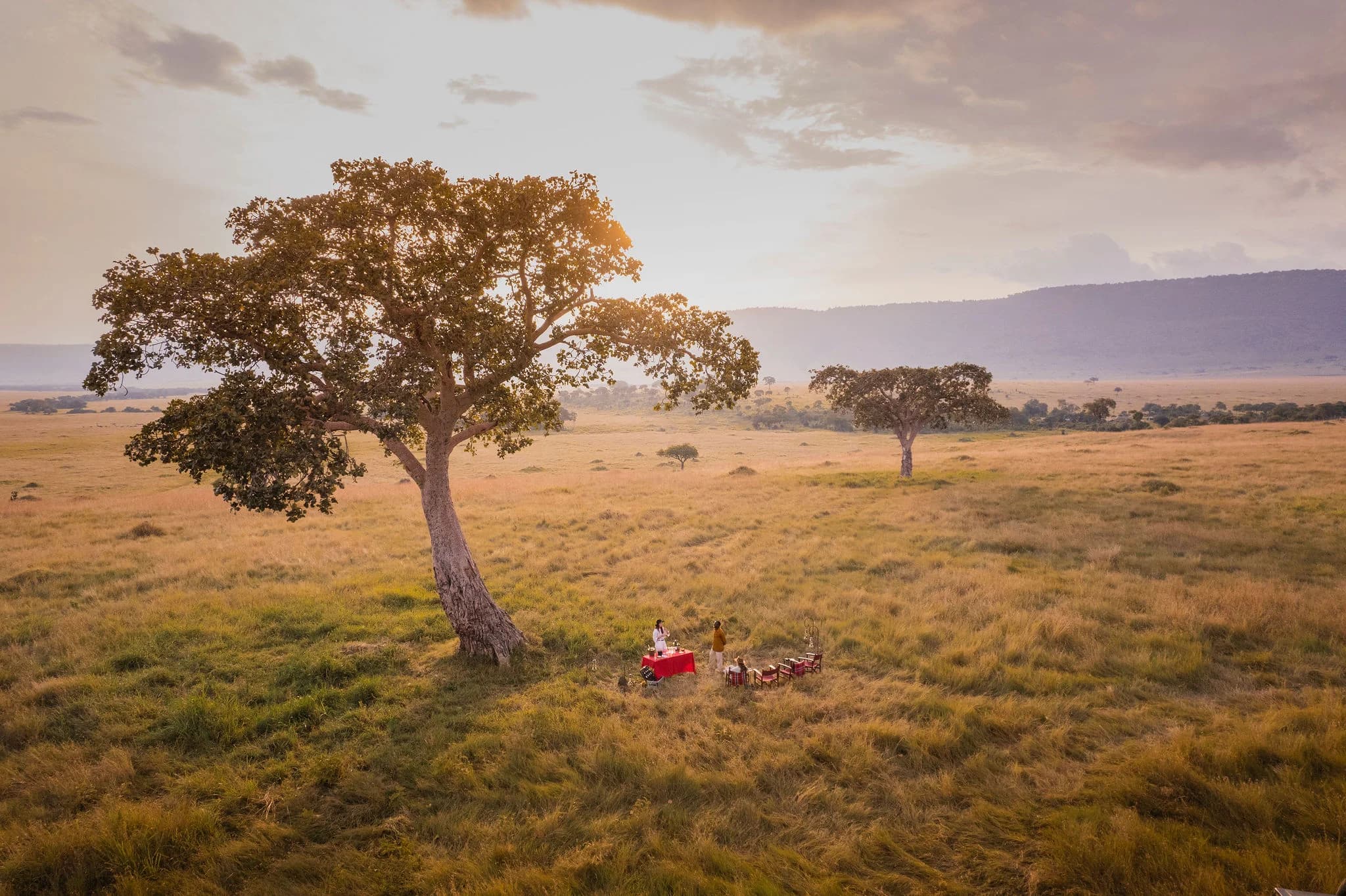 Aerial view of Angama Safari Camp at sunset — Photo: Angama / Teagan Cunniffe
Aerial view of the Mara river winding through the Mara North Conservancy — Photo: Angama / Teagan Cunniffe
The drive to that location is itself part of the experience. The return — in the dark, with the night sounds beginning — completes it. There is no lodge lobby to walk into. There is the camp, lit by lantern, waiting at the edge of the plain.
The Table
In a camp of six, dinner is not a restaurant experience — it is a shared one. The guide joins the table. The day's sightings are relived in detail. The cook, who has been working under canvas with the same dedication as any kitchen in a permanent lodge, produces food that has no business being this good given the circumstances.
 Dinner at Angama Safari Camp — Photo: Angama / Teagan Cunniffe
Bush dining at Angama Safari Camp is not a performance of wilderness — the fire, the stars, the sounds from beyond the camp's perimeter are simply there, unrehearsed. The table happens to be in the middle of them.
Getting Here: Angama Safari Camp is accessed by charter from Nairobi Wilson Airport to a private airstrip in the Mara North Conservancy. The flight takes approximately 45 minutes. The camp is most naturally combined with two or three nights at Angama Mara — the two properties sit in the same conservancy, offer complementary perspectives on the same ecosystem, and share a guide team.
When to Visit: The Great Migration crossing runs July through October, with peak river crossings in August and September. The camp repositions twice annually to track the herds. Outside migration season, the Mara North Conservancy holds outstanding predator concentrations year-round — the same lion and leopard territory, without the elevated visitor numbers of peak weeks.
Afrilux9 Verdict: Angama Safari Camp is the third argument in what is, taken together, one of the most complete safari propositions in Africa: the escarpment view from Angama Mara, the mountain silence of Angama Amboseli, and the plains immersion of the Camp. Each resolves a different desire. The Camp resolves the oldest one — the wish not to observe the wilderness but to sleep inside it, separated from it by nothing but canvas and the particular quality of attention that a place like this demands.
Inspired by This Journey?
Search flights and hotels to start planning your own African escape.
Begin Your Journey