Born Free, Still Wild: Elsa's Kopje and the Lioness That Named a Park
Most safari names you arrive at. This one arrived first. Before the lodge, before the rhino sanctuary, before the airstrip and the charter and the long green plains running north to the Nyambeni Range, there was a lioness called Elsa — raised by hand on this ground by Joy and George Adamson, returned to the wild, and turned by a book and a film into one of the most famous animals of the twentieth century. The park took its character from her story. The hill above George Adamson's old camp took her name.
Elsa's Kopje is the solo flagship of the Elewana Collection, and it does not feel like anything else in the portfolio. It is built directly into the rock of Mughwango Hill, its cottages woven so completely into the boulders of the granite kopje that the lodge seems less constructed than uncovered. The plains spread out below toward Mount Kenya in the haze. There is memorabilia from the Adamson years on the walls, and the past is close enough to touch.
What there is not, mostly, is anyone else. Meru National Park is one of the great wildernesses Kenya keeps to itself — vast, watered, alive, and visited by almost no one. You come here not for the spectacle of crowds gathered around a kill, but for the rarer thing: the sense of having a whole park to yourself.
The Legend
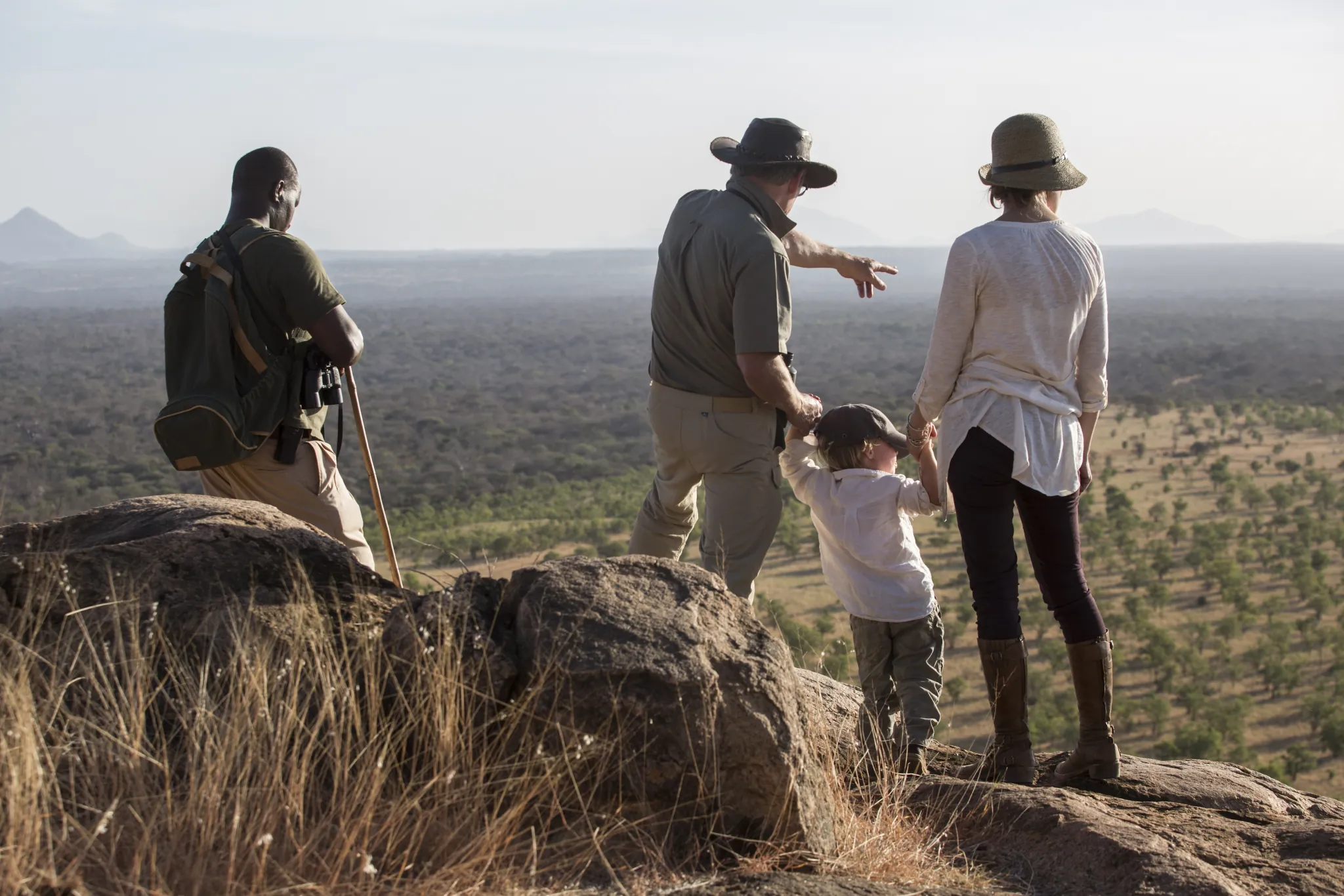 A guide and family looking out over the Meru plains from Mughwango Hill, the Nyambeni Range in the far haze — Photo: Elewana Collection
The Adamsons' story is woven into every part of this place, but it is never reduced to a theme. George Adamson made his camp at the foot of this hill, and it was here that Elsa — orphaned, hand-reared, and against every received wisdom returned successfully to the wild — became the lioness the world would meet in Joy Adamson's Born Free. The book reached millions. The film reached more. Between them they did something rare: they made an argument for wild animals living wild lives, and they made it stick.
Meru is the landscape that argument was set in. To stand on Mughwango Hill, where the guides still tell the story, is to understand that conservation here is not an abstraction bolted onto a holiday. It is the founding fact of the place.
The Hill
 Aerial view of Elsa's Kopje woven into the rock and vegetation of Mughwango Hill, the plains beyond — Photo: Elewana Collection
There is a particular intelligence to how the lodge sits on its hill. Rather than levelling the rock and building on top of it, Elsa's Kopje was threaded between the boulders — cottages and suites following the contours of Mughwango, linked by stone paths that climb and turn with the hillside. From the air it nearly disappears into the green.
The reward of that restraint is the view. Every cottage looks out over the Meru plains, which run unbroken to the Nyambeni Range in one direction and toward Mount Kenya in another. There are Safari Cottages, Honeymoon Suites, a Family Cottage and a Private House with its own pool — but the architecture's central idea is shared by all of them: you are not staying near the wilderness, you are staying inside it, level with the hawks.
The Suite
 A Honeymoon Suite at Elsa's Kopje, the open-air bathtub framing the plains through a wide window — Photo: Elewana Collection
Inside, the cottages carry the same logic. Walls of hand-finished plaster flow around the rock; thatched roofs lift overhead; and the bathtub — open-air, framed by a wide window onto the plains — is positioned so that the view is never more than a glance away. The line between the room and the hillside it is built into is deliberately blurred.
It is a romantic place, unapologetically so, and the Honeymoon Suites lean into it. But the romance is of a specific kind: not gilt and excess, but stone, canvas, candlelight and an empty country of thirteen rivers beyond the glass.
The Sanctuary
 A guide scanning the bush from an Elewana game-drive vehicle in Meru — Photo: Elewana Collection / Oliver Fly Photography
The quiet conservation triumph of Meru sits behind a fence on the floor of the park: an 84-square-kilometre rhino sanctuary, holding more than a hundred animals — over seventy white and more than thirty black — and breeding them successfully. In a country where rhino numbers are counted and guarded like state secrets, that is an extraordinary figure, and it exists almost entirely out of public view.
Game-driving Meru is unlike the Mara or Amboseli. The park is generous with water and short on visitors, so the wildlife is spread across a green, river-laced expanse rather than concentrated into a handful of well-known circuits. You track at your own pace. You rarely share a sighting. And the rhinos — the heart of the recovery — are here in numbers that most parks can only envy.
The Northern Specials
 Reticulated giraffe in the bush at Meru, one of the region's distinctive northern species — Photo: Elewana Collection / Oliver Fly Photography
North of the equator, the wildlife changes. Meru sits at the edge of Kenya's arid north, and with it comes a cast of species you will not find further south — the so-called northern specials. The reticulated giraffe, its coat a clean geometry of polished tiles. The Grevy's zebra, narrow-striped and big-eared. The gerenuk, standing on its hind legs to browse. The lesser kudu, the Somali ostrich, the Beisa oryx. Each is a small thrill of the unfamiliar.
The birdlife matches the mammals for richness: more than four hundred and fifty species recorded across the park. A morning's drive here is less a hunt for the Big Five than a slow accumulation of the rare and the regional — the kind of game-viewing that rewards patience and curiosity over a checklist.
The River
 A guest fishing on one of Meru's permanent rivers — Photo: Elewana Collection / Oliver Fly Photography
What makes Meru green is water. Thirteen permanent rivers cross the park, fed off the slopes of the highlands, and they give Elsa's Kopje something most Kenyan lodges cannot offer: a special licence to do the things the wilderness more typically forbids. Here you may walk, you may fish, and you may drive at night.
The fishing is for catfish, tilapia and barbel on the Tana and Rojewero, a rod in hand on a near-private river. The walking — on Mughwango Hill and below it, with age limits for younger guests — puts you on foot in country you would otherwise only watch from a vehicle. And the night drives open a second, nocturnal park entirely. Few places in Kenya grant all three. Meru, almost empty and entirely wild, is one of them.
Getting Here: Elsa's Kopje is reached by scheduled flight from Nairobi's Wilson Airport — roughly forty-five minutes in the air — followed by a short drive into the park to Mughwango Hill. International arrivals connect via Nairobi.
When to Visit: Meru is a year-round park, watered by its thirteen permanent rivers when others run dry. The drier months sharpen game-viewing as wildlife draws to the water, while the rains bring vivid green and exceptional birding across the four hundred and fifty recorded species.
Afrilux9 Verdict: Elsa's Kopje is the rare lodge that earns its fame honestly — not by trading on a famous name, but by being faithful to what that name stands for. It is built with restraint into a hill above the camp where conservation history was made; it looks out over a near-private wilderness of rivers, rhinos and northern specials; and it offers the walking, fishing and night-driving that almost nowhere else in Kenya can. For travellers who measure a safari by solitude rather than spectacle, Meru is the country's best-kept secret, and Elsa's Kopje is the only way to keep it.
Imagery and property information courtesy of The Elewana Collection (@elewanacollection), which retains all rights.
Inspired by This Journey?
Search flights and hotels to start planning your own African escape.
Begin Your Journey