The Gateway Ritual: Gran Meliá Arusha and the Road to the Serengeti
There is a school of thought that says the journey to the Serengeti begins the moment you land in Kilimanjaro. We disagree. It begins the evening before, in Arusha — the small city at the foot of Mount Meru that has served as the departure point for East African expeditions for over a century. Get that night right, and everything that follows is framed correctly.
Gran Meliá Arusha is the most considered answer to that question currently available in northern Tanzania.
Arusha: The Art of the Threshold
Arusha occupies a specific geography in the imagination of the safari traveller. It is not a destination in itself — it is a hinge. The Serengeti, Ngorongoro Crater, Tarangire, Kilimanjaro: all depart from here, and all return to it. The city's purpose is preparation and decompression, and most hotels in the area treat it as such — functional, forgettable, a bed before the early transfer.
Gran Meliá has refused that logic.
 The open lobby of Gran Meliá Arusha, framed by gardens
The hotel's architecture makes its position clear from arrival: the lobby opens entirely onto a tropical garden, dissolving the boundary between interior and exterior in a way that feels deliberate rather than accidental. The proportions are generous. The materials — stone, warm timber, curated textiles — speak a language closer to residential than hospitality. This is a hotel that has been designed for guests who know the difference.
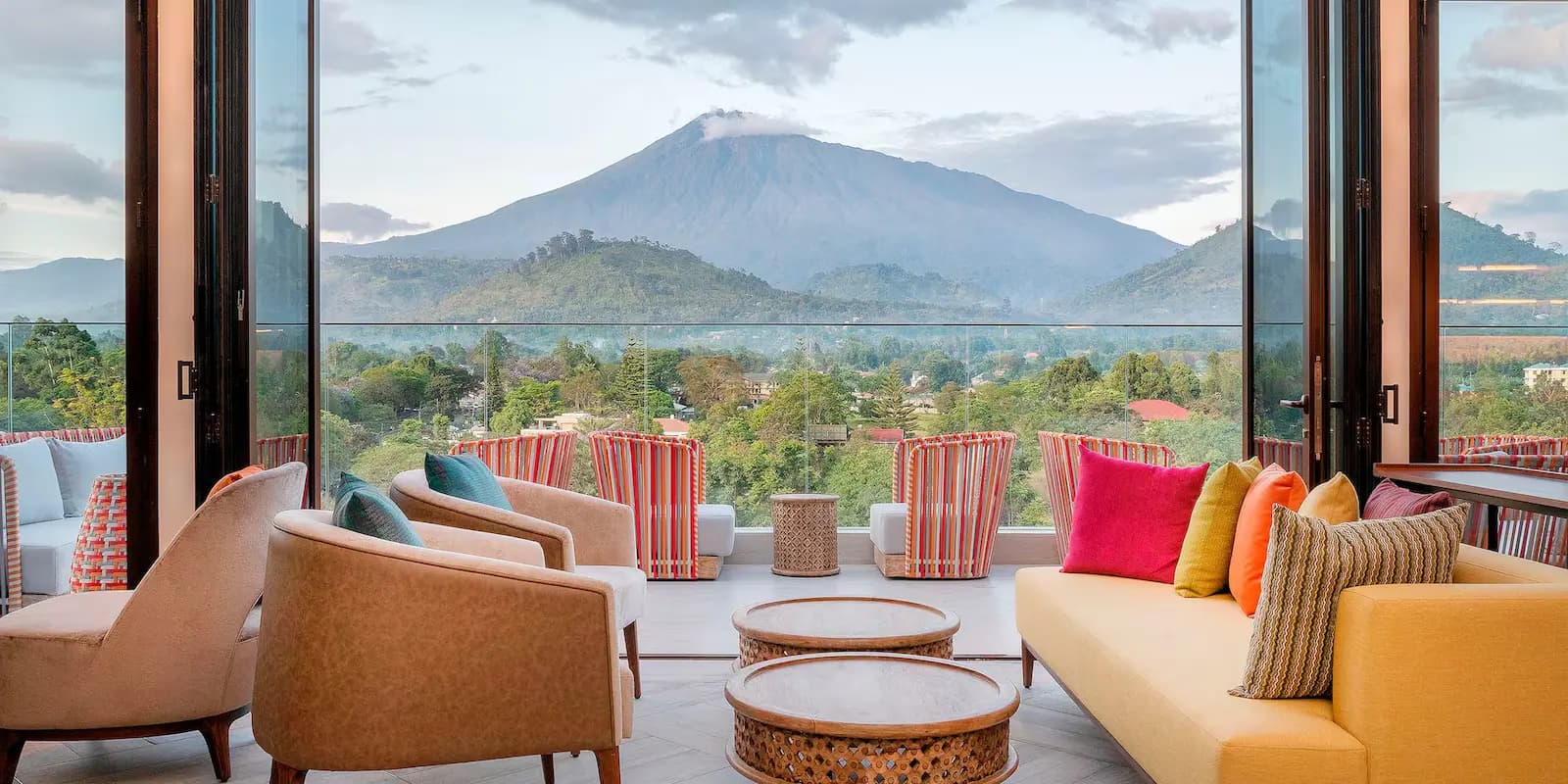
The lounge, positioned to frame Mount Meru directly through floor-to-ceiling glass, is the hotel's best room. We say this not as hyperbole but as practical guidance: if you arrive in the early evening, as most Kilimanjaro connections suggest you will, sit here. Order something cold. Watch the mountain change colour as the light drops. This is the decompression that allows the safari to begin on its own terms.
 Gran Meliá Arusha's pool set against the tropical gardens
The pool follows the same principle — scale and setting over spectacle. It runs long and calm beneath the palms, and at this altitude (Arusha sits at 1,400 metres), the afternoon air carries a freshness that most guests find genuinely surprising after the heat of the coast or the European winter they've just left behind.
Practical Note: Kilimanjaro International Airport is approximately 45 minutes from the hotel. Most guests connect here via Nairobi, Addis Ababa, or Doha — JRO has strong international coverage. The hotel can arrange onward transfers to any Serengeti airstrip or directly to Ngorongoro, a drive of approximately three to four hours.
The Transition
The elephant is the animal that announces the Serengeti before you arrive.
 A herd of elephants at a watering hole on the approach to the Serengeti
The road south from Arusha passes through the agricultural highlands and then drops, gradually, into the acacia-dotted corridor that signals you are entering a different ecological register. Elephant sightings on this route are common, particularly in the dry season when animals range wider in search of water. By the time the plains open up ahead of you, the mind has already begun to slow.
This transition — from city hotel to wilderness — is the journey that the two Meliá properties have been designed to support. The Gran Meliá provides the civilised beginning; what follows is another proposition entirely.
Meliá Serengeti Lodge: Plains Without Apology
Meliá Serengeti Lodge sits on a ridge above the central Serengeti, looking south across a grassland that extends, apparently, to the horizon. The building makes no attempt to hide. It announces itself from the plains below as a long, low structure in the ochre tones of the dry-season grass — present without being intrusive, which is the precise balance this landscape demands.
 Meliá Serengeti Lodge on its ridge above the golden plains
Rooms face the plains directly. This is not a detail but a position: the Serengeti is the view from the bed, the bath, the private terrace. The decision about where to orient a room is an editorial one, and Meliá has made it correctly.
What distinguishes this lodge within its category is its scale. Larger than a tented camp, it offers a level of facilities — a full spa, multiple dining options, a properly equipped gym — that the intimate bush camps cannot. For travellers who want the Serengeti experience without sacrificing the infrastructure of a full-service hotel, it occupies a distinct and currently underserved position.
The Balloon
At dawn, the central Serengeti hosts something that has no adequate equivalent elsewhere.
 Hot air balloons drifting over the Serengeti plains at dawn
The balloon safari launches before light and drifts south with the prevailing wind, the plains below revealing themselves in the golden hour with a patience that a game drive cannot replicate. From altitude, the scale of the ecosystem becomes comprehensible in a way it never quite does from the vehicle. The wildebeest herds — during migration season, hundreds of thousands of animals — resolve from a pattern in the grass into individual creatures, then back into a pattern as the balloon rises.
Book this at the time of lodge reservation. It fills early in season and is not the kind of experience that benefits from a waiting list.
The Human Serengeti
The Serengeti is Maasai land. It has been so for centuries, and the relationship between the Maasai people and the ecosystem they have coexisted with — herding cattle along migration corridors, reading weather in ways that no meteorological model has fully replicated — is as much a part of this landscape as the wildlife itself.
 A Maasai warrior at dusk on the Serengeti plains
The lodge facilitates Maasai cultural visits as part of its activities programme. These encounters, when conducted properly, are among the most grounding experiences a Serengeti stay can offer — a reminder that the wilderness you are moving through is not untouched, but tended, and that the people who have tended it carry knowledge that took generations to accumulate.
Afrilux9 Verdict: The Gran Meliá pair solves a problem that more celebrated safari operators ignore: the transit night. For travellers who are serious about how a journey begins and ends, having a hotel in Arusha that matches the quality of what follows is not a small thing. It is the difference between a trip that feels assembled and one that feels considered. The Serengeti lodge, meanwhile, offers the central plains at a scale and service level that the intimate camp market does not cover — a genuine gap, filled well.
Inspired by This Journey?
Search flights and hotels to start planning your own African escape.
Begin Your Journey