Breakfast on the Water: Kilindi Zanzibar and the Domes by the Sea
There is a particular kind of quiet that belongs only to the Indian Ocean coast — a quiet made of warm air, distant surf, and the soft creak of a dhow somewhere out on the water. Kilindi sits inside that quiet. It is the Elewana Collection's only piece of coastline, and it makes its case not through grandeur but through restraint: fifteen villas, fifty acres, one long stretch of white-sand beach, and very little else.
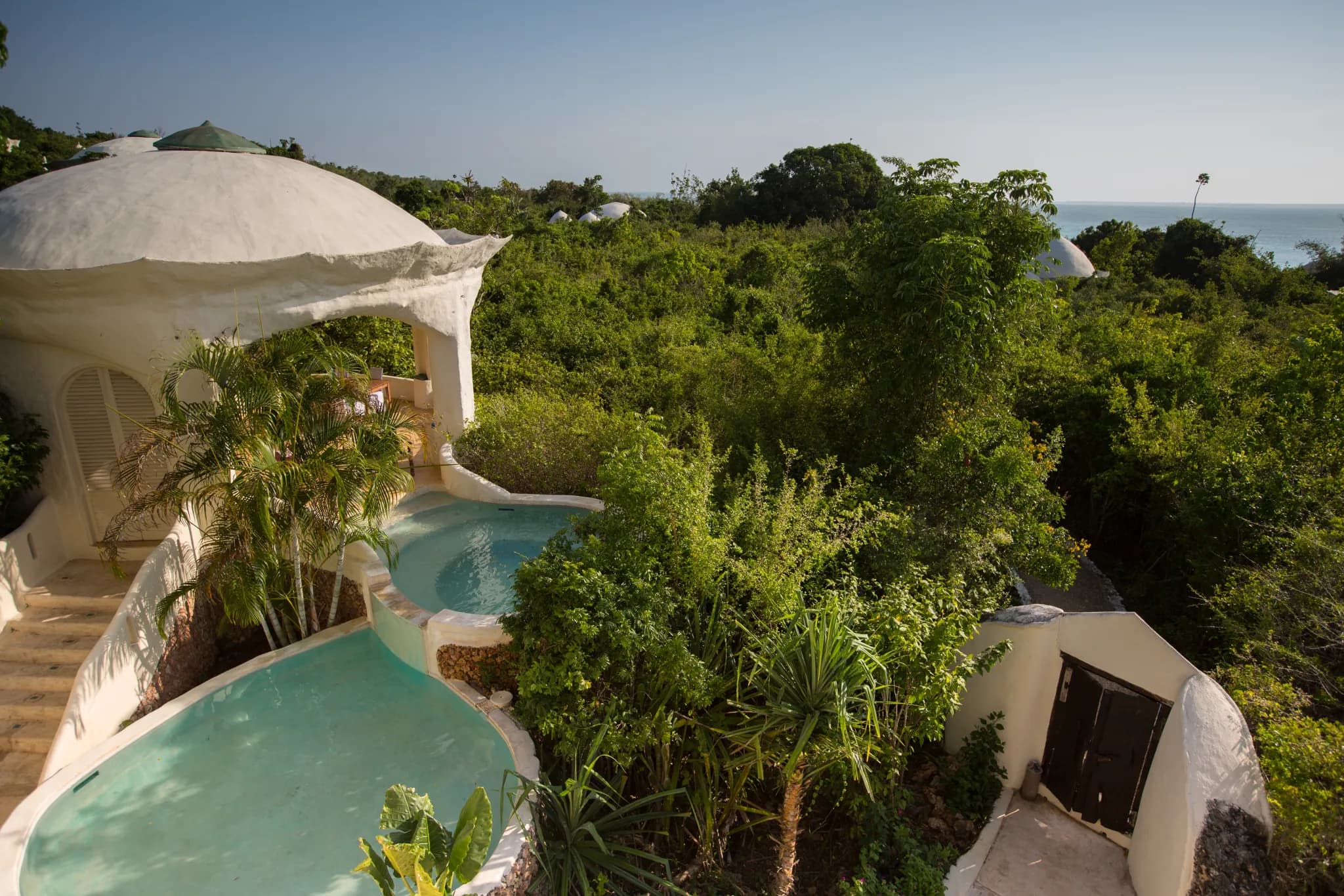
The villas are the first surprise. They are domed — pavilion-like structures of curved white plaster, half Moorish and half something entirely their own, scattered through gardens of palm and frangipani on a slope above the sea. There are no straight lines to speak of, no corridors, no front desk in the conventional sense. You arrive and the building seems to dissolve into the foliage around it.
This is the north-west coast, where the bay is shallow and turquoise and the sand stays white late into the day. It is the part of the collection that has nothing to do with game drives or migrations — and that, after a fortnight on safari, is precisely the point.
The Domes
The architecture is the thing people remember. Each of the fifteen villas is a freestanding white dome, soft-edged and sculptural, set among the trees so that no two quite face each other.
 A white domed villa at Kilindi Zanzibar, set among tropical gardens above the beach — Photo: Elewana Collection
The effect is of a small village that grew out of the hillside rather than one that was placed upon it. Curved walls, arched openings, and rounded thresholds replace the right angles you stop noticing in ordinary buildings — and their absence, here, is felt as a kind of ease. There is nowhere a corner can hide. The villas come in three forms — garden-facing, beach-facing, and a larger two-bedroom — but the language of plaster and curve runs through all of them.
The Villa
Inside, the dome opens upward into a single uninterrupted volume: a four-poster bed under a fall of white muslin, polished floors the colour of bone, and a wide arched doorway that frames the ocean and frames almost nothing else.
 The interior of a beach-facing domed villa at Kilindi Zanzibar, opening to the Indian Ocean — Photo: Elewana Collection
Each villa has its own private plunge pool, set on a deck just beyond the doorway, so the boundary between sleeping, swimming, and sitting in the sun grows pleasantly indistinct. There is no clamour of resort amenity. The intent is unambiguous: this is a place built for honeymoons and for the kind of holiday where the most strenuous decision is whether to read in the shade or the sun.
The Floating Breakfast
Kilindi's signature gesture is a small one, and all the better for it. Breakfast is brought not to a table but to the water — a wooden tray of fruit, pastries, and coffee floated out across the surface of your own plunge pool.
 A floating breakfast tray drifting on a private plunge pool at Kilindi Zanzibar — Photo: Elewana Collection
It is the sort of flourish that could easily tip into gimmick, and at most places it would. Here it does not, because everything around it is so unhurried — the tray simply turns slowly in the water while you reach for the coffee, the petals drifting, the morning still cool. The kitchen leans Swahili and seafood-forward the rest of the day, the spice-island larder put to obvious use.
The Ocean
The beach is private and the bay beyond it is shallow, clear, and threaded with sandbars that surface at low tide. A dhow crosses it most afternoons, its single sail catching the light, exactly as dhows have crossed these waters for a thousand years of monsoon trade.
 A traditional dhow crossing the turquoise bay in front of Kilindi Zanzibar — Photo: Elewana Collection
The water is the point of the place. Snorkelling and diving reach the coral; boat trips run out to find dolphins; catamaran cruises and sunset dhow sails fill the late afternoons, and deep-sea fishing the early mornings. Paddleboards and kayaks sit free for the taking on the sand. None of it is compulsory. The bay is just as happily watched from a sun lounger as it is entered.
Stone Town
An hour or so down the coast lies Stone Town, the old island capital and a UNESCO World Heritage Site — a labyrinth of coral-rag alleys, carved doors, and crumbling Omani merchant houses that grew rich on the spice trade.
 A Swahili dining setup in the gardens at Kilindi Zanzibar — Photo: Elewana Collection
This was the clove, nutmeg, vanilla, and pepper capital of the western Indian Ocean, and the trade's residue is everywhere — in the cuisine, the architecture, the layered Arab, Indian, and African inheritance of the town. A guided Stone Town walk reads it like a text; a spice-farm tour does the same with your hands and nose. Both are an easy day from Kilindi, and both make the floating-breakfast version of Zanzibar feel earned rather than merely pleasant.
Jozani
For one morning, the coast gives way to forest. Jozani, in the island's interior, is the last significant stand of Zanzibar's native woodland, and the only place on earth to see the endemic Zanzibar red colobus — a russet-coated monkey found nowhere else, moving through the canopy in troops of thirty to fifty.
The day trip is short and unstrenuous, a boardwalk through the trees and a quiet hour with the colobus overhead. It is the one excursion that reminds you Zanzibar is an island with an ecology of its own and not merely a beach — a thread back to the wider purpose of the collection, even at its most restful outpost.
Getting Here: Kilindi sits on Zanzibar's north-west coast, roughly an hour and fifteen minutes by road from Abeid Amani Karume International Airport, which connects to Dar es Salaam, the Tanzanian mainland, and a growing roster of international routes. Most guests arrive at the end of a northern-circuit safari, the island a deliberate counterweight to the bush.
When to Visit: The coast is at its finest in the long dry seasons — June through October, and again December into February — when the skies are clear and the sea its most inviting. The longer rains of March to May are best avoided for a beach stay.
Afrilux9 Verdict: Kilindi is not trying to be the most dramatic place in the Elewana Collection, and it is the better for knowing it. It is a coda — the soft, slow, salt-aired chapter that follows the dust and the early starts of safari. The domes are genuinely distinctive, the plunge pools and the floating breakfast deliver exactly the unhurried romance they promise, and Stone Town and Jozani sit close enough to keep the mind engaged when the body has finally stopped moving. For a honeymoon, or for the last week of a long African journey, there are few more graceful places to come to rest.
Imagery and property information courtesy of The Elewana Collection (@elewanacollection), which retains all rights.
Inspired by This Journey?
Search flights and hotels to start planning your own African escape.
Begin Your Journey