4.8 Square Kilometres of Sky: The Three Faces of Loisaba
There is a particular silence that belongs to high country, and Loisaba has it. The conservancy sits on an escarpment in Laikipia, the great plateau north of Mount Kenya where the highland forest gives way to acacia and red earth and the air thins enough to make the mountain seem closer than it is. From the cliff edge the land falls away in a single uninterrupted sweep, and on a clear morning Mount Kenya holds the southern horizon like a held breath.
What makes Loisaba unusual is not the view, striking as it is. It is that the conservancy lets you choose how close to the ground you want to sleep. Three camps share the same wilderness, and each offers a different altitude of intimacy with it — a clifftop lodge with a private host for every room, a set of tents so widely spaced that each bed commands nearly five square kilometres to itself, and a handcrafted four-poster wheeled out each night to the lip of a kopje so that you wake beneath nothing at all.
It is one place, experienced three ways. The wildlife is the same — the elephants, the elusive black leopard, the reticulated giraffe of the northern arid country. What changes is the distance between you and the sky.
The Conservancy
Loisaba covers a stretch of Laikipia that matters out of all proportion to its size. Laikipia holds Kenya's second-largest elephant population, and Loisaba is a key breeding area and migration corridor within it — the herds move through on routes older than any fence.
 The escarpment edge at Loisaba, the Laikipia plateau falling away toward Mount Kenya — Photo: Elewana Collection
This is also northern Kenya, which means the animals here are not the ones you meet in the Mara. The conservancy is home to the northern specials — the finely drawn reticulated giraffe, the Grevy's zebra with its pinstripe coat, the Beisa oryx and the greater kudu — species that belong to the arid country above the equator and give a Loisaba game drive a different cast entirely. Elewana is the conservancy's sole tourism partner, which is part of why the land feels so unhurried: the vehicles you pass on a drive, if you pass any, are your own.
Lodo Springs
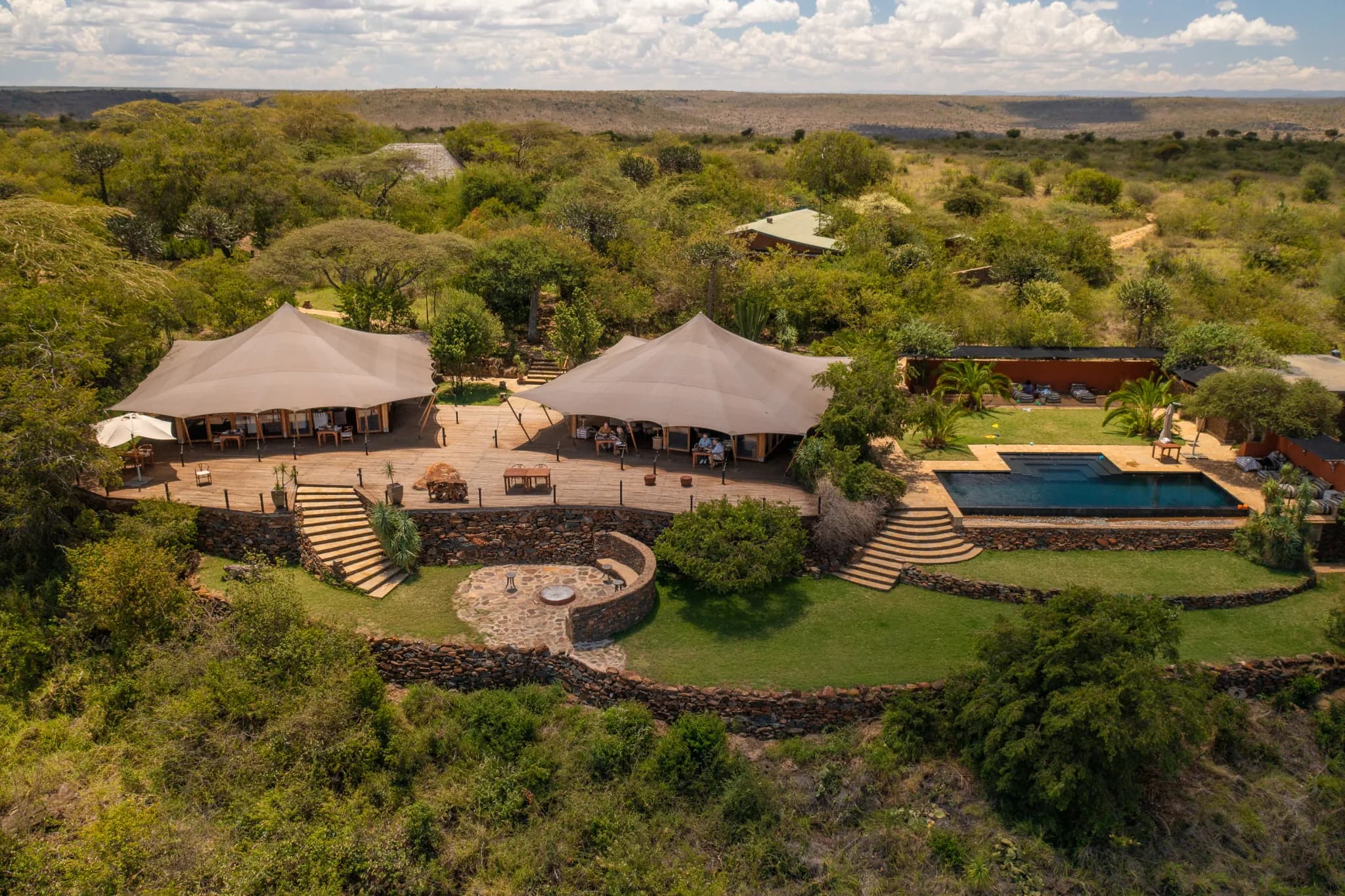
Lodo Springs is the camp for those who want the high country without giving up a single comfort. Eight en-suite tents — canvas and timber, glass walls, private decks — are strung along the top of the escarpment, and a clifftop infinity pool hangs over the drop with Mount Kenya beyond it.
 The lounge and deck at Loisaba Lodo Springs, looking out across the Laikipia plateau — Photo: Elewana Collection
The detail that defines Lodo Springs is quieter than the architecture. Each room is assigned its own Elewana Guest Ambassador — not a butler in the formal sense, but a single person who learns your rhythm and shapes the day around it, from the hour you take coffee to the place you watch the sun go down. With only eight tents, the effect is of a private house in which everyone happens to know exactly what you want before you do.
The Tented Camp
If Lodo Springs is the polished face of Loisaba, the Tented Camp is its most extravagant gesture toward space. The arithmetic is the point: across the conservancy, the camp works out to roughly 4.8 square kilometres of wilderness for every bed — a figure that places it among the most exclusive addresses in East Africa.
 A luxury tent interior at Loisaba Tented Camp, glass-walled and open to the escarpment — Photo: Elewana Collection / Mario Moreno
The tents stand at the escarpment edge, timber-floored and glass-walled, each with a private deck cantilevered toward the view. An open-sided thatched pavilion holds the lounge and dining, and the infinity pool reaches out over the cliff toward the mountain. Nothing about the camp announces its exclusivity; it simply gives you so much room that you forget anyone else is staying at all. That, in the end, is what 4.8 square kilometres per bed buys — not a number, but the experience of a private wilderness.
The Star Beds
And then there is the camp that does away with the roof entirely. The Loisaba Star Beds sit on a rocky kopje above a permanent waterhole, and the beds themselves are handcrafted four-posters mounted on raised platforms — wheeled out each night, by hand, to the open edge so you fall asleep under the full reach of the sky.
 A star bed rolled out beneath the night sky at Loisaba — Photo: Elewana Collection / Silverless
The Milky Way over the star bed platform at Loisaba, a night timelapse — Photo: Elewana Collection
The hosts here are the warriors who know this country best — Samburu and Laikipia Maasai who run the camp and sit with you at the fire, and whose presence turns a night under the stars from a novelty into something closer to a homecoming. There is no light pollution to speak of. The Milky Way is not a smudge but a structure, and the waterhole below carries on its night business — the soft business of drinking and moving — while you lie there watching the sky turn.
The Black Leopard
For all its open-sky romance, Loisaba is a serious wildlife conservancy, and it holds one creature that is rarely seen: the black leopard, the melanistic form so elusive that for years it went all but unrecorded. Loisaba is among the very few places on earth where it has been reliably photographed.
 A leopard on Loisaba conservancy, the rosettes of its coat catching the light — Photo: Elewana Collection
You should not come expecting to see it — that would be to misunderstand the thing entirely. The black leopard is rare precisely because it does not perform. But knowing it is out there, somewhere in the broken country below the escarpment, changes the quality of every drive. The conservancy's lion are far more obliging, prowling across the open ground in the early light. The black leopard remains the shadow at the edge of all of it.
The Living Laboratory
What ultimately distinguishes Loisaba from a merely beautiful place is that it is a working laboratory of African conservation, and a guest can watch the science happen. The conservancy partners with The Nature Conservancy, and its land hosts a roster of long-running research programmes — Space for Giants studying the elephants, Lion Landscapes working on coexistence between big cats and people, and the San Diego Zoo's Reticulated Giraffe programme tracking a species in quiet decline.
 A reticulated giraffe on Loisaba, one of the northern specials the conservancy's research tracks — Photo: Elewana Collection / Mario Moreno
The model is multilateral by design: community, NGOs, research, tourism and agriculture sharing one landscape rather than competing for it. For the guest this is not an abstraction. You can join a visit to the conservancy headquarters, watch the anti-poaching tracker dogs at work, sit in on lion tracking, or spend an afternoon learning how a Grevy's zebra is identified by its stripes. It is the rare safari where the conservation is not a brochure line but the thing you are actually watching.
Getting Here: Loisaba is reached by a one-hour scheduled flight from Nairobi's Wilson Airport to the Loisaba airstrip, followed by a fifteen-minute drive into the conservancy. All three camps — Lodo Springs, the Tented Camp and the Star Beds — share the same access, and a single stay can move between them.
When to Visit: Laikipia rewards visitors year-round; its highland setting keeps the climate temperate and the game resident rather than migratory. The drier months sharpen wildlife viewing as animals concentrate around permanent water, while the open-sky nights at the Star Beds are clearest away from the long rains.
Afrilux9 Verdict: Loisaba is the most quietly ambitious place in the Elewana collection — not one lodge but three answers to the same question of how close to the wild you wish to lie. Lodo Springs gives you the high country with an ambassador at your shoulder; the Tented Camp gives you a private wilderness measured in square kilometres; the Star Beds take away the roof altogether and hand you the Milky Way and a Samburu warrior to share it with. Underneath all three runs a serious conservation engine and the faint possibility of a black leopard. It is, in every sense, a conservancy worth choosing how to sleep in.
Imagery and property information courtesy of The Elewana Collection (@elewanacollection), which retains all rights.
Inspired by This Journey?
Search flights and hotels to start planning your own African escape.
Begin Your Journey