Cape-Dutch in the Crater Highlands: The Manor at Ngorongoro
There is a particular pleasure in arriving somewhere that refuses to look like where you are. You have come to Tanzania for the wild — for the crater, the rhino, the plains that empty into haze — and instead you find yourself standing before a gabled white house with a Cape-Dutch façade, surrounded by clipped lawns and rose beds, with the smell of coffee blossom on the air. The effect is deliberate, and it is disarming.
The Manor at Ngorongoro sits in the cool, green highlands above the crater, on a working coffee plantation, and it has been called one of the most lavish addresses on the entire safari circuit. It is the kind of place where the gravel crunches just so, where a fire is lit before you think to want one, and where the day's wildness is bracketed at both ends by deep comfort.
This is the unusual proposition of the Manor: that the threshold to the eighth wonder of the world should be a country house. You descend into one of the highest concentrations of wildlife in Africa by day, and return by evening to high tea on the lawn and a bath drawn against the highland chill.
The Manor
The main house is the heart of it — a Cape-Dutch country estate transplanted, improbably and entirely successfully, to the Tanzanian highlands.
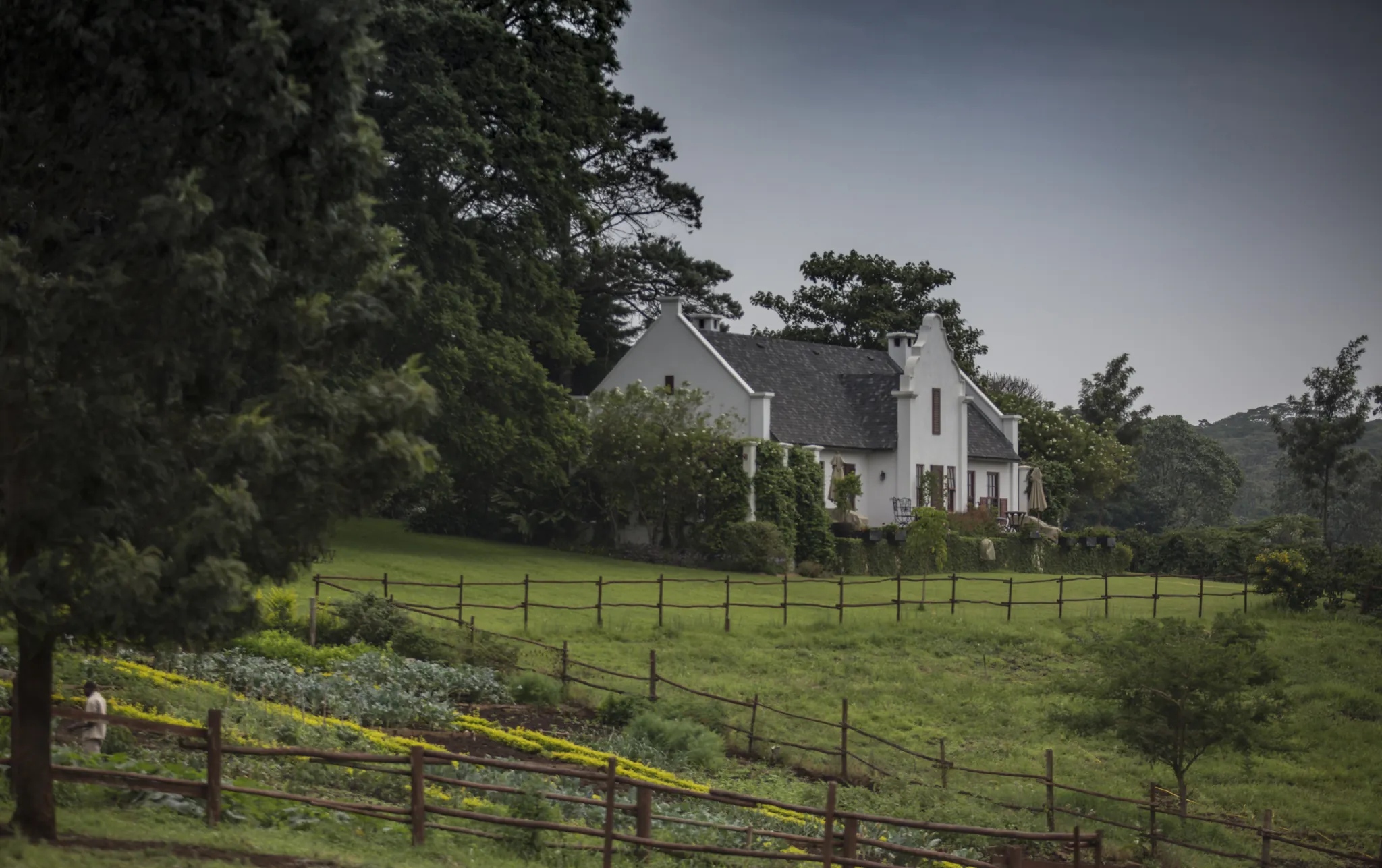 The Cape-Dutch manor house at The Manor at Ngorongoro, amid its gardens — Photo: Elewana Collection / Silverless
Inside, the register is country-house rather than safari-lodge: old-world grandeur in the Cape-Dutch style of yesteryear, deep sofas arranged around fires. There is no attempt to dress the place up as a tent or a bush camp. It is, frankly, a manor — and that confidence is what makes it work. After a day on the crater floor, the contrast between the elemental and the elegant is the entire point.
Accommodation is in cottage suites and a dedicated family cottage, set across the grounds, each with its own bathtub, sun seats and outdoor space. The architecture keeps the highland cold at a distance and the comfort close.
The Plantation
The Manor stands on a working coffee plantation, and the estate does not let you forget it. The rows run away from the lawns toward the tree line; the gardens are kept with the same care as the crop.
 Clipped lawns and a relaxing area in the manor gardens — Photo: Elewana Collection / Silverless
A coffee tour walks you through the cycle from tree to cup — the picking, the pulping, the drying, the roasting — and ends, as the best of these things do, with a cup of what you have just watched being made. Horse rides set out across the plantation and the surrounding highlands and finish, by arrangement, with sundowners as the light goes. The plantation is the reason the air smells the way it does and the reason the grounds feel less like a lodge and more like a private estate that happens to take guests.
The Crater
And then there is the reason you are here at all. A short descent from the highlands drops you onto the floor of the Ngorongoro Crater — a collapsed volcanic caldera that holds one of the highest densities of wildlife anywhere in Africa.
 Dramatic skies over the Ngorongoro Crater — Photo: Elewana Collection / Silverless
The crater is the rare place where famous concentrations of big game are gathered within a single, contained bowl of grass and soda lake, and it is among the surest places on the continent to see black rhino — the animal that has become the shorthand for everything conservation is fighting to keep. Lion, elephant, buffalo, flamingo in their thousands on the lake shallows: the density is the spectacle. You do not range across vast distances here in search of game. You descend into a natural amphitheatre and find it already full.
The Private Picnic
The crater's fame is also its complication. It is one of Tanzania's most visited places, and on a busy morning the rim road can feel like a queue. The Manor's answer is to step out of it.
 A private bush banquet set up on the crater floor — Photo: Elewana Collection
The lodge holds access to a private campsite on the crater floor, set apart from the public picnic sites, where lunch is laid out properly — linen, glassware, a banquet under the open sky — while the crowds gather elsewhere. To eat at a private table on the floor of the caldera, with rhino somewhere in the middle distance and the rim rising green all around, is to experience the eighth wonder on something closer to your own terms.
The Highlands
The crater is the headline, but the Manor sits at the centre of a wider highland country worth more than a single descent.
 Horse riding across the Ngorongoro highlands at the Manor — Photo: Elewana Collection / Silverless
Lake Manyara lies within reach — famous for its tree-climbing lions, an oddity of behaviour you will find almost nowhere else, and for the flamingos that turn its shallows pink. Beyond it is Olduvai Gorge, among the celebrated highland excursions the Manor sets out for. Closer to home there are nature walks, bush lunches and rides through the coffee and the cool highland air. The Manor is one of the rare safari addresses where the days between game drives are as full as the game drives themselves.
The Family Table
It is also, quietly, one of the most child-friendly places on the circuit — a fact the country-house setting makes easy to overlook.
 The dining room at The Manor at Ngorongoro — Photo: Elewana Collection / Silverless
There are pony rides for small children where their parents take the horses, gentle "L'il Bee" massages, a private cinema and a family cottage built for the purpose. Meals are taken in the manner of a country house — high tea on the lawn, dinner in the dining room, a fire and a quiet drink after the children have gone up. For a family travelling to the crater, the Manor solves the problem that defeats most safari lodges: how to make the wild legible and comfortable for the young without diluting it for the rest.
Getting Here: The Manor at Ngorongoro is reached via Lake Manyara Airstrip — roughly a 30-minute flight from Arusha — followed by a 60-minute drive up into the highlands. Arusha connects to the international gateways at Kilimanjaro and beyond.
When to Visit: The crater holds resident wildlife and is rewarding year-round; its sheer density means game viewing rarely disappoints. The dry months from June to October offer the easiest travelling and the clearest light over the caldera, while the green-season rains bring lush highland colour and flamingos to the soda lakes.
Afrilux9 Verdict: The Manor at Ngorongoro is a study in deliberate contrast — a Cape-Dutch country house, complete with lawns and a coffee plantation, set as the threshold to one of the wildest places on earth. The pairing should not work, and instead it is the whole pleasure of the place: the crater's density of life by day, the manor's old-world comfort by night, and a private table on the caldera floor to keep the eighth wonder from feeling like a crowd. For families especially, it is hard to think of a more graceful way to meet the Ngorongoro.
Imagery and property information courtesy of The Elewana Collection (@elewanacollection), which retains all rights.
Inspired by This Journey?
Search flights and hotels to start planning your own African escape.
Begin Your Journey