Above the Cloud Line: Gorilla Trekking with Singita Kwitonda, Rwanda
There is a particular quality of light in the Volcanoes National Park at altitude — cool and white, filtered through mist and eucalyptus — that signals immediately that you are somewhere unlike any other part of Africa. The landscape here does not seduce. It asserts.
Singita Kwitonda Lodge sits at the foot of the Virunga volcanoes in Rwanda's northwest, at the edge of the last remaining mountain gorilla habitat on earth. The word 'last' is not rhetorical. The mountain gorilla exists nowhere else. What Kwitonda offers its guests is structured access to one of the rarest wildlife encounters available to a modern traveller — and the architecture, food, and philosophy to make the experience worthy of what surrounds it.
Arriving at Kwitonda
The approach from Kigali — Rwanda's immaculate capital — takes approximately two and a half hours by road, winding through tea estates, terraced hillside farms, and the increasingly cool air of the highlands. Singita can arrange transfers; the drive itself is worth paying attention to, as it provides the geographic and human context that makes the park and its conservation story legible.
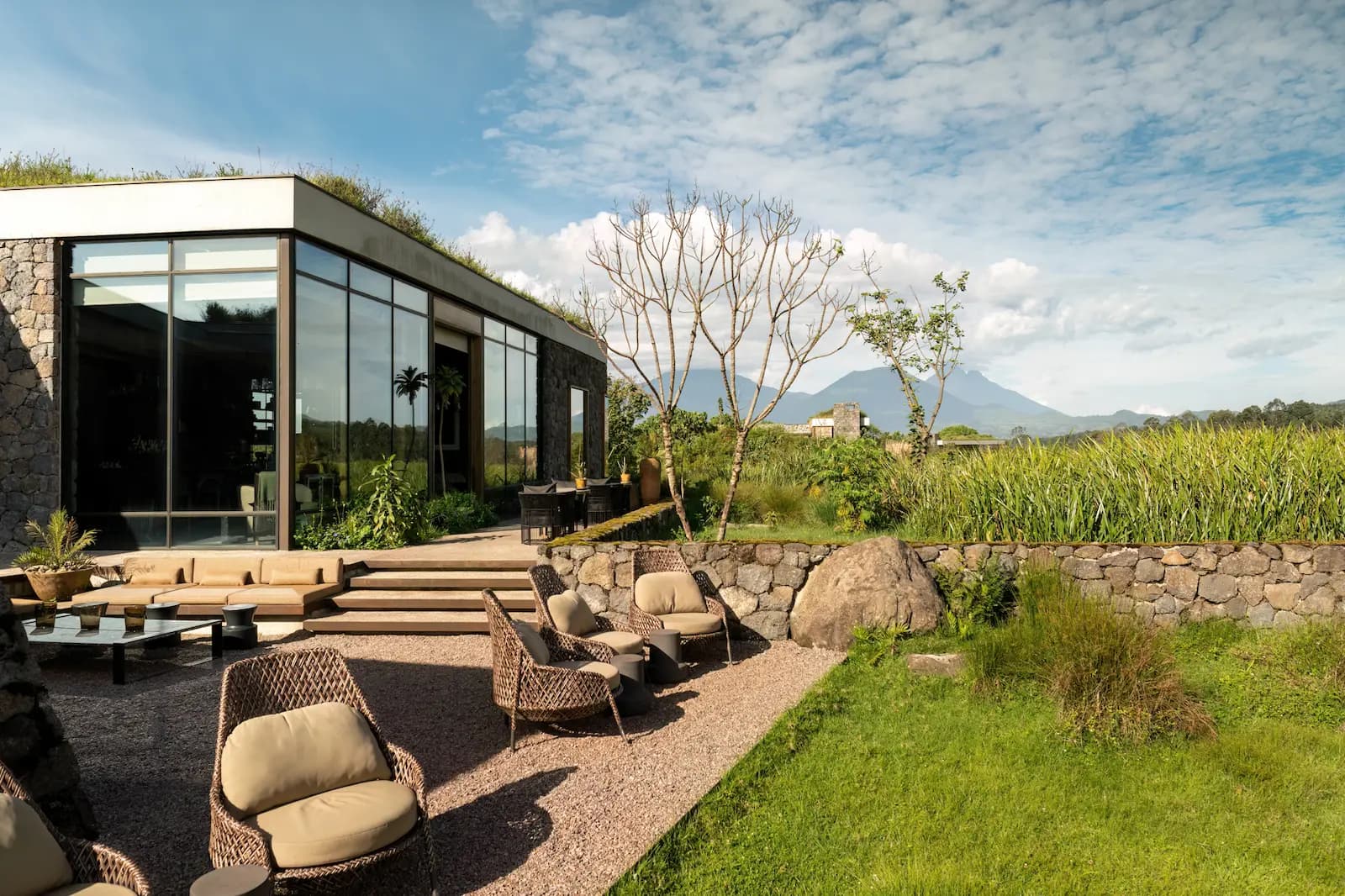 Singita Kwitonda Lodge against the Virunga volcano backdrop
The lodge design draws from the landscape and its materials — stone, timber, deep-pitched rooflines that echo the volcanic silhouette behind. Suites are large, warm, and oriented to frame the dramatic views across the farmlands toward the forested slopes above. There is a spa, a wellness programme, and a rhythm to days here that is slower than Serengeti, more contemplative. The altitude encourages it.
Practical Note: Kigali International Airport has direct connections from major European hubs and is increasingly well-served by Africa's own airlines. Rwanda is one of the continent's most accessible destinations by air, and among the easiest to navigate on the ground. Gorilla trekking permits must be arranged in advance and are limited by daily quota — Singita handles this as part of the booking process.
The Trek
The morning begins before first light. After a briefing from your ranger at the park boundary, you enter the forest on foot.
 The bamboo forest trail ascending toward the gorilla habitat
The terrain rises steeply through bamboo and Hagenia forest, and the trek can last anywhere from forty minutes to four or five hours depending on where the gorilla family has moved since the previous day's sighting. Park rangers track their location continuously; the time on the trail is part of the experience, not an inconvenience.
When you arrive at the family, you are permitted one hour. That hour is the reason for everything else.
Mountain gorillas share 98% of human DNA, and no amount of preparation prepares you for the immediate, unsettling familiarity of their gaze. A silverback at rest will regard you with the particular expression of something that has decided you are uninteresting — and this dismissal is its own form of privilege. The infants tumble and chase. Females move through the undergrowth with focused economy. The alpha patrols without hurry.
 A mountain gorilla in the Virunga forest
There is no reasonable description of this encounter that does not sound insufficient. Go, and form your own.
Golden Monkey Tracking
For those who want a second morning in the forest, golden monkey tracking offers a different experience entirely — faster, more chaotic, and in a different altitude band of the park.
 Golden monkeys in the bamboo forest
The Cercopithecus kandti is endemic to the Albertine Rift and moves in groups through the bamboo with a speed and energy that makes the gorilla trek feel almost meditative by comparison. The tracking is physically lighter — shorter distances, lower terrain — and the encounter is closer to comic than solemn. Both are essential.
Kwitonda's Conservation Framing
In 2025, Singita Kwitonda was designated a Long Run Fellow — a recognition given to organisations that demonstrate measurable commitment to conservation, community benefit, culture, and commerce as an integrated model. This is not a certification that flatters; it requires documented outcomes.
The lodge participates in gorilla habituation programmes, community visits, and direct support of the Dian Fossey Gorilla Fund — the research organisation whose work in these mountains has been foundational to the survival of the mountain gorilla population, which currently numbers just over 1,000 individuals globally. Kwitonda guests can visit the Fund's campus and meet the researchers, which transforms the trek from a wildlife experience into an encounter with active conservation science.
Insider Note: Request a visit to Kwitonda's conservation room before your trek briefing. The context it provides — population recovery data, habituation timelines, ranger fieldwork — changes what you observe in the forest, and what you carry home from it.
Farm-to-Table at Altitude
One of the quieter pleasures of a Kwitonda stay is the food. The lodge operates a farm-to-table culinary programme drawing directly from Rwanda's extraordinary agricultural productivity: sweet potatoes, climbing beans, maize, sorghum, coffee, and tea grown within sight of the dining room.
Wine experiences, imported from Singita's South African programme, provide an unexpected continental reference point. A long lunch with a glass of good Stellenbosch red, the volcanoes appearing and disappearing in the afternoon mist — this is the particular luxury that Kwitonda offers and the Serengeti cannot: an intellectual, as much as sensory, travel experience.
Afrilux9 Verdict: Rwanda is the Africa that surprises people who think they already know the continent. Kigali's modernity, the highland landscape's austere beauty, and the moral weight of an encounter with mountain gorillas make this one of the most complete travel experiences on earth. Singita Kwitonda provides the appropriate frame: rigorous luxury, genuine conservation purpose, and the understanding that in Rwanda, the two have never been in conflict.
Inspired by This Journey?
Search flights and hotels to start planning your own African escape.
Begin Your Journey