A Room in the Baobabs: Tarangire Treetops and the Elephant Capital
There is a particular silence that settles over Tarangire in the dry season — not an absence of sound, but a fullness of it, the low register of a landscape that has not been interrupted. Doves. The dry rasp of wind through baobab branches. And, if you wait, the soft tearing of grass somewhere below as an elephant feeds.
Tarangire Treetops stands alone in this. The camp occupies a 312-square-kilometre private wildlife area bordering Tarangire National Park, with no other lodge in sight and no other vehicle on the track. Its rooms are not on the ground at all. They are raised on platforms among the baobab and marula trees, level with the canopy — a luxury treehouse in the most literal sense, where the branches stand close on every side and the floor of the bush lies a storey below.
You arrive, as the early travellers did, with the sense of having gone somewhere the map does not quite reach. The trees were here first. The camp was built around them.
The Treehouse
The rooms are the reason to come. Each one is lifted into the trees on timber platforms, reached by a flight of wooden stairs that climb past the trunk of a baobab and deliver you, slightly out of breath, into a room set among the branches.
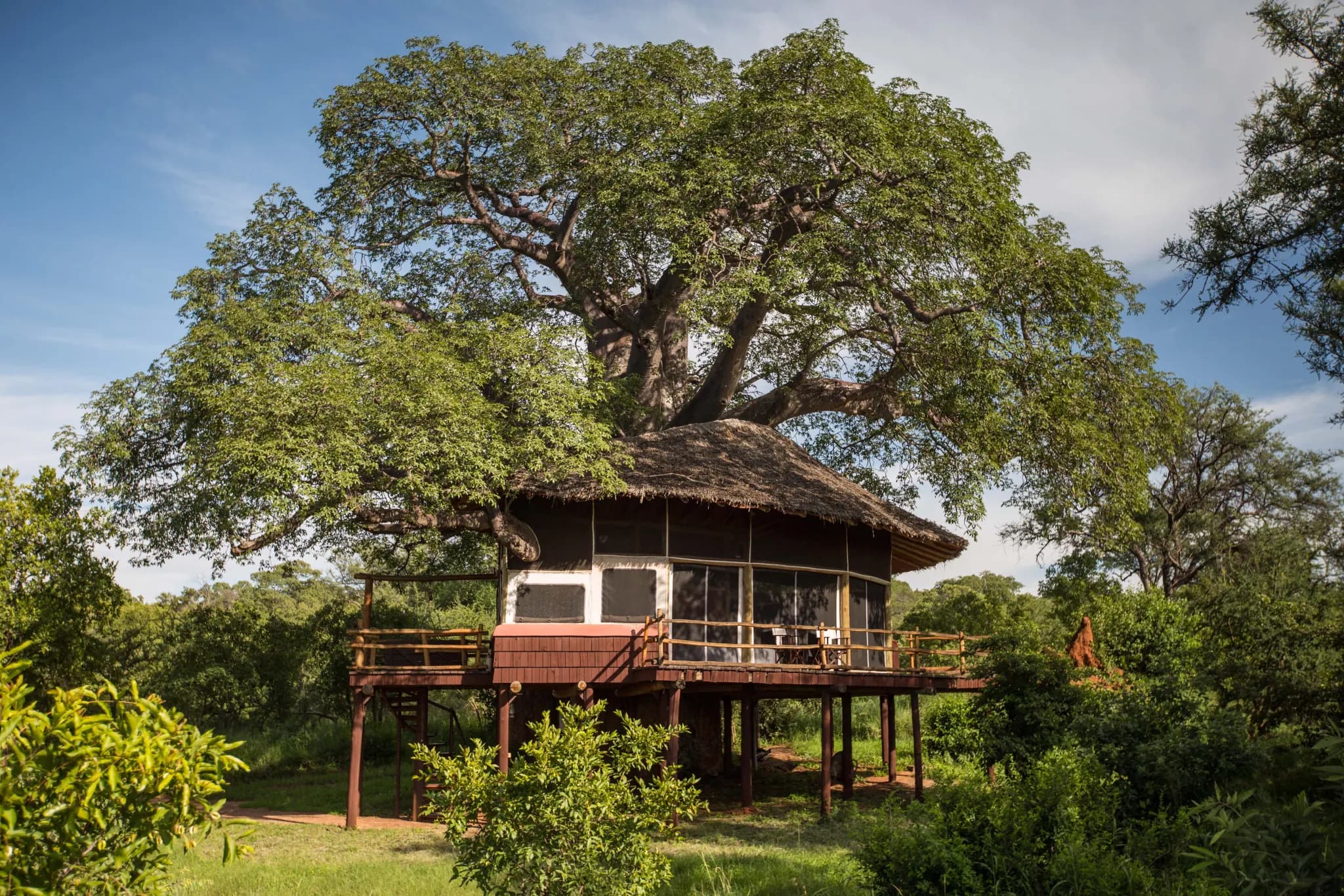 Exterior of a treehouse suite at Tarangire Treetops, raised among the baobabs — Photo: Elewana Collection
The staircase climbing into a treehouse suite at Tarangire Treetops, set among the baobab branches — Photo: Elewana Collection
Inside, the room makes no attempt to hold the wilderness at arm's length. Floor-to-ceiling netting opens it to the canopy on three sides, so the bed faces out into branches and sky rather than walls. There is a writing desk, a deep bath, the slow ceiling fan turning overhead — and beyond all of it, the bush, at the height the birds keep.
 Interior of a treehouse suite at Tarangire Treetops, opening through netting to the canopy — Photo: Elewana Collection
Waking here is a quiet event. The light arrives first through the leaves, then across the plain, and for a while the only thing that moves is whatever has come to feed beneath you.
The Baobabs
It is impossible to spend a night in this camp and not become preoccupied with the baobabs. They are the oldest living things in the landscape, swollen and grey and improbable, and they have gathered to themselves a great weight of meaning.
 Guests on a walking safari beneath an ancient baobab at Tarangire Treetops — Photo: Elewana Collection
The ecology is remarkable on its own terms: the baobab stores water in its great trunk, is said to stand for centuries, and feeds an entire community of creatures from its flowers and fruit. But the Maasai who guide the walks here carry the other half of the story — the folklore that has the trees planted upside down by an exasperated creator, their roots left waving at the sky. Standing beneath one at dusk, you find both versions equally persuasive.
Bush walks set out on foot among them, a guide reading the ground and the bark, explaining which animals shelter in the hollows and which depend on the fruit. It is the kind of walking that recalibrates the scale of things.
The Elephant Capital
Tarangire earns its reputation in the dry months. As the surrounding country bakes and the seasonal water vanishes, the wildlife concentrates around the remaining water, and the elephants arrive in numbers found almost nowhere else on the continent.
 A guest watching elephants gather at a waterhole below Tarangire Treetops — Photo: Elewana Collection
The park holds more than three thousand elephants in the dry season — one of the finest elephant-viewing areas in Africa. They come in family groups, the matriarchs leading, the calves stumbling at the rear, to drink and dust and feed beneath the very trees the camp is built among. From a game vehicle, or from the deck of your own room, the spectacle is of a kind that no amount of advance description prepares you for: not a single sighting but a procession, hour after hour, of the largest land animals on earth going calmly about their lives.
The Migration Path
The camp sits on something older than any itinerary — an annual elephant-migration path, a route the herds have followed across this country for generations, drawn by water and memory between the park and the wider ecosystem.
 Elephants moving across the Tarangire plains beneath a flight of pelicans — Photo: Elewana Collection
To be camped on that path is to understand the place differently. The elephants are not visiting Tarangire Treetops; in a sense the camp is a guest on their road. They pass through the private area on their own schedule, and the privilege of the stay is simply to be present when they do — to watch a line of them cross the open ground at the pace of something that has nowhere it needs to hurry to.
Randilen
None of this solitude is accidental. Tarangire Treetops is one of the largest contributors to the Randilen Wildlife Management Area — a model in which neighbouring communities set aside land for wildlife and share in the returns of protecting it.
 Maasai dancers gathered beneath a baobab after dark near Tarangire Treetops — Photo: Elewana Collection
The arrangement is what keeps the corridor open and the migration path intact: communities living in genuine harmony with the wildlife rather than in competition with it. A cultural visit to a Maasai village makes the relationship plain — the land that holds the elephants also holds the people who have chosen to share it, and the camp's presence is part of why that choice continues to make sense. For children, the days fold in warrior training and the telling of the baobab's stories.
The Solitude
What lingers, after the elephants and the trees, is the quality of the quiet. There is no neighbouring lodge, no convoy of vehicles at a sighting, no horizon broken by anyone else's camp.
 Aerial view of Tarangire Treetops standing alone in its private wilderness area — Photo: Elewana Collection
From the air, the camp resolves into a few thatched roofs lost in a great expanse of bush — proof, if it were needed, of just how alone you are out here. Days end at a small pool, or around a fire, or with a sundowner watching the light go out of the plain. The 312 square kilometres belong, for the length of your stay, almost entirely to you and to whatever walks through.
Getting Here: Tarangire Treetops is reached via Kuro Airstrip — a 20-minute flight from Arusha followed by a drive of roughly an hour and a half to camp. Arusha connects to the rest of the northern circuit and to international arrivals at Kilimanjaro.
When to Visit: The dry season is the moment to come. As water disappears from the surrounding country, the elephants and other wildlife concentrate around the remaining water, gathering in the great numbers for which the park is known — among the best elephant viewing anywhere in Africa.
Afrilux9 Verdict: Tarangire Treetops is a rare combination of two things that rarely sit together: genuine wilderness solitude and a room you will not want to leave. The treehouse conceit could so easily be a gimmick; here it is the whole point, a way of living for a few nights at the height of the canopy, on a path the elephants have always walked, in a corner of Tanzania that almost no one else reaches. It is, quietly, one of the most distinctive places to stay on the northern circuit.
Imagery and property information courtesy of The Elewana Collection (@elewanacollection), which retains all rights.
Inspired by This Journey?
Search flights and hotels to start planning your own African escape.
Begin Your Journey